|
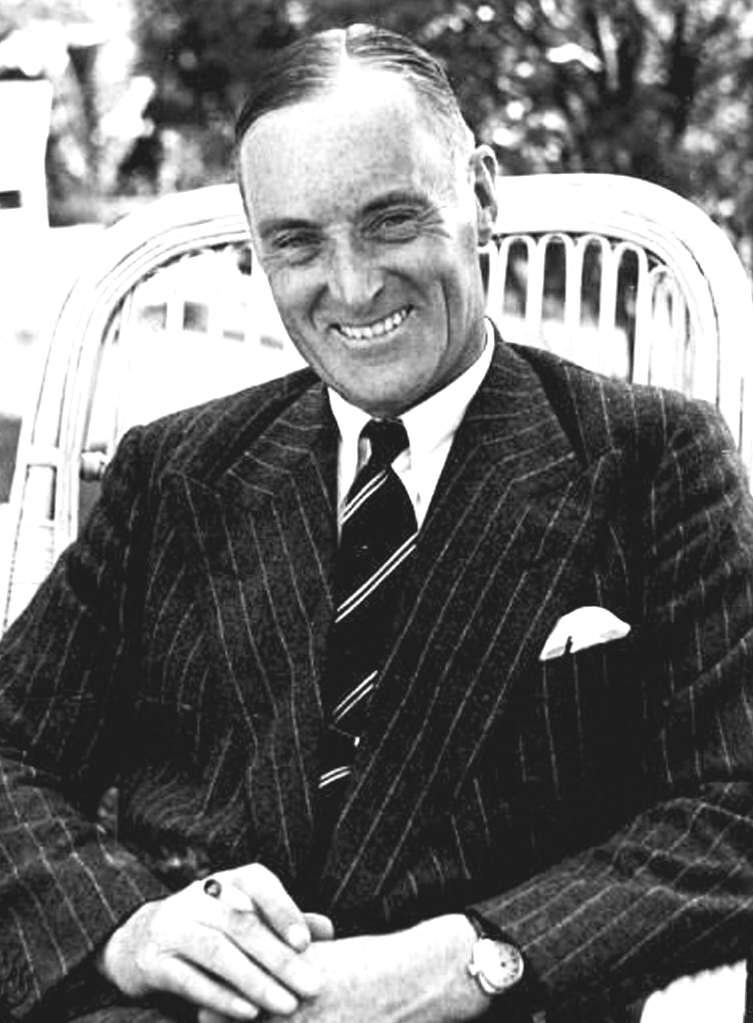
MALCOLM CAMPBELL 1885 - 1948
|
|||||||||||||||||||||||
|
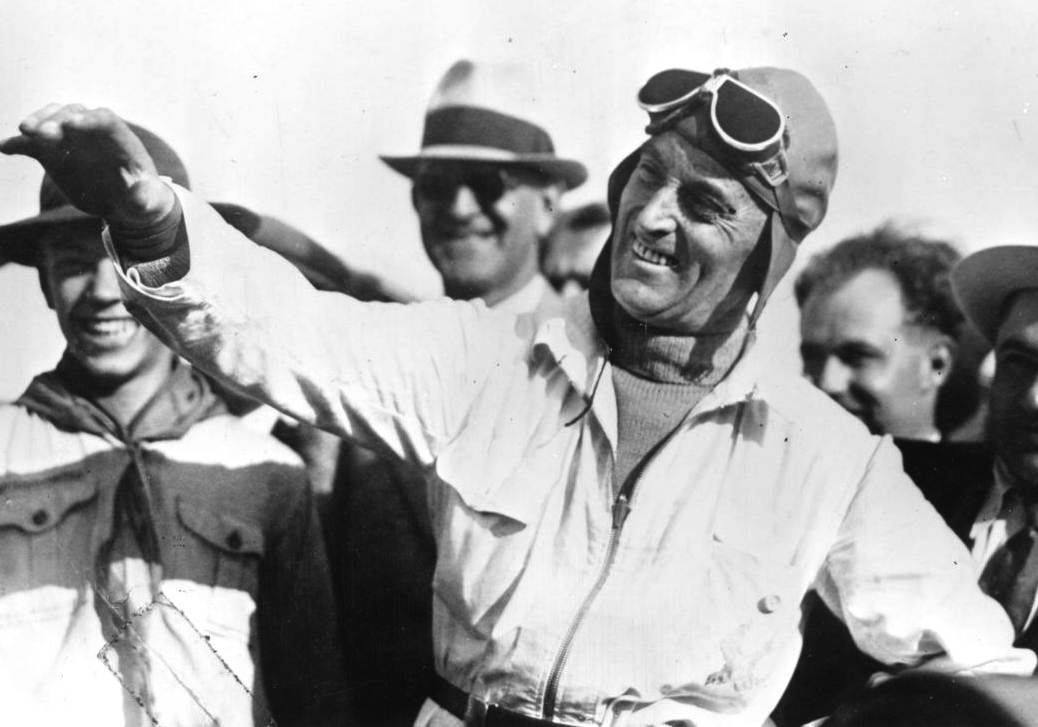
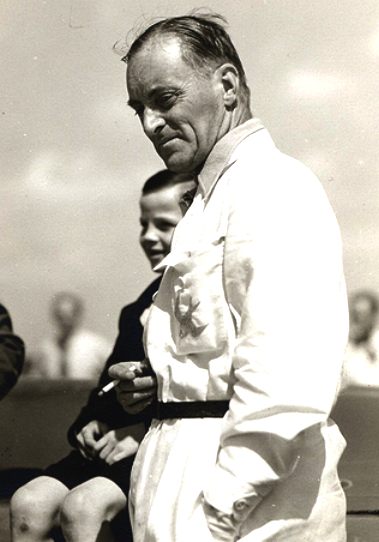
Malcolm Campbell was born in Chislehurst, Kent, England in 1885. He was the son of a diamond merchant. He attended the independent Uppingham School. In Germany, learning the diamond trade, he gained an interest in motorbikes and races. Returning to England, he worked for two years at Lloyd's of London for no pay, then for another year at one pound a week. Between 1906 and 1908, he won all three London to Lakes End Trials (motorbike races). In 1910 he began racing cars at Brooklands. What a glorious time to live in.
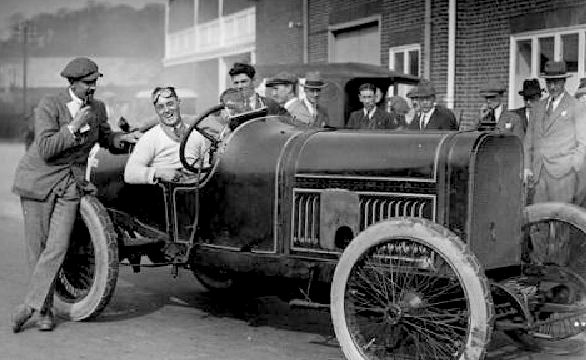
After an early interest in bicycling and motorcycles, in 1910 he purchased his first car, a "Darracq" which he christened "Bluebird" (a name that he used for all is subsequent record cars and presumably because it made him feel happy). Along with other models, he raced this car at the legendary motor racing circuit, Brooklands.
When the war started he was drafted into the Royal Flying Corps, having had some flying experience at Brooklands in various aircraft including one he had constructed himself, and he spent his time ferrying aircraft back and forth across the English Channel. In 1918 he published a very small but amusing book entitled ‘Hints to Beginners on Flying’ in which he recounted his stories as Lt. M. Campbell, subsequently to be promoted to and known as Captain Campbell.
In 1921 one Kennelm Lee Guinness (inventor of the K.L.G. spark plug) drove a V-12 Sunbeam down the Brooklands Railway Straight at 135 mph, entering the finishing straight at 140 mph. During practice on the 16th May 1922 KLG was timed by friends on the Railway Straight at 144 mph and on the following day in windy conditions he clocked an official 140.51 mph one way to take a new Brooklands lap record of 123.39 mph along with several other speed records over various distances.
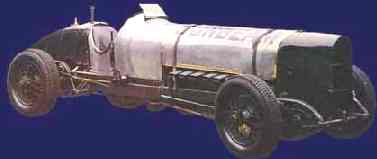
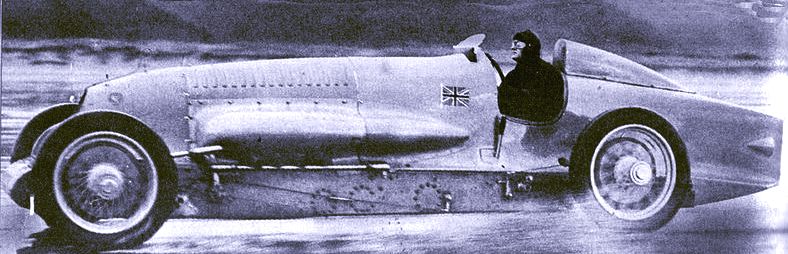
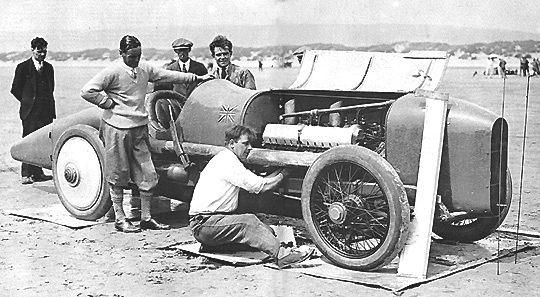
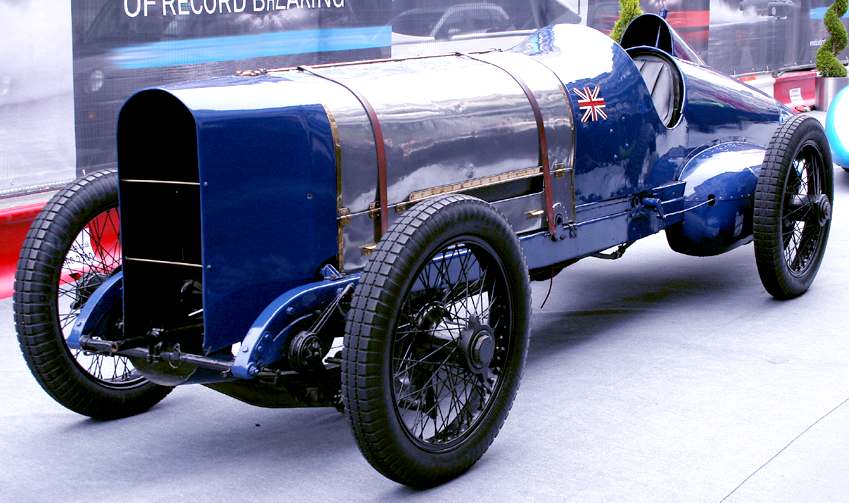
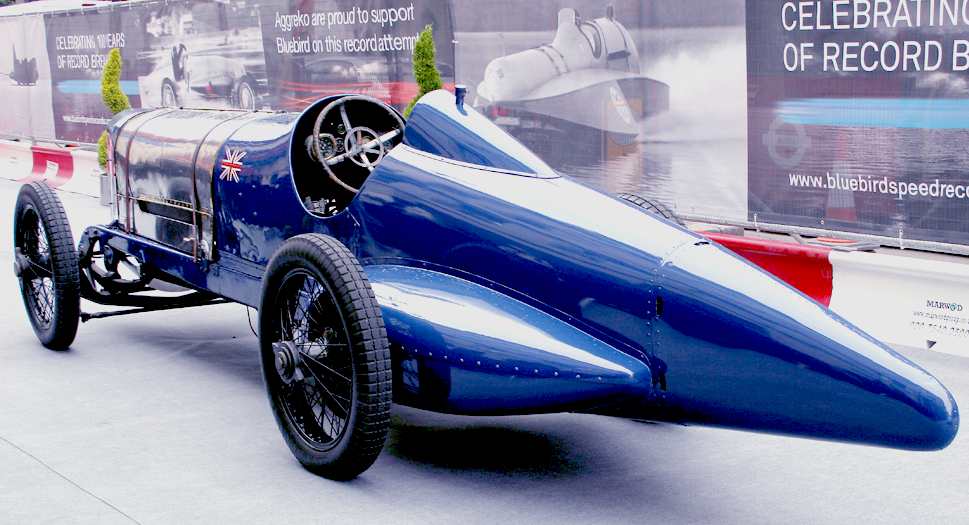
Sunbeam 350hp 1924 - 1925
This Sunbeam was subsequently bought by Malcolm Campbell for a price which has never been disclosed, which after a refurbishment he painted it blue, named it Bluebird and took to the Fanoe Island speed trials in Denmark where although it recorded a speed of 146.4 mph, which was never internationally recognised, even though the timing apparatus had been properly certified.
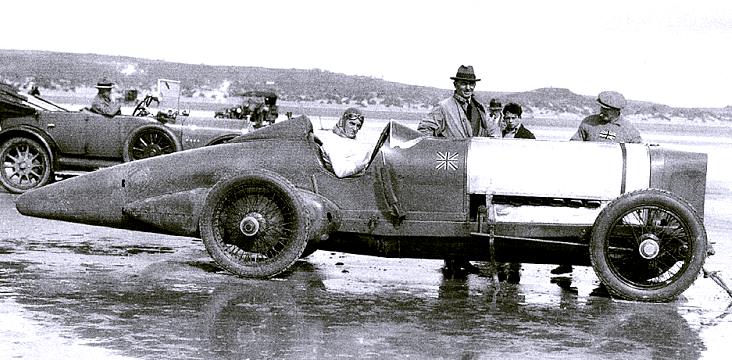
Campbell however, was not a man to be easily defeated and after a lot of expensive tuning work and several abortive outings he took the car to Pendine Sands in September 1924 where he recorded an official two-way kilometre of 146.16 mph, 0.015 of a second faster that Eldridge's previous record set in a Fiat at Arpajon in France. Immediately afterwards he put the car up for sale for £1,500 but then relented and decided to spend some more time on it when he learned that Parry Thomas was about to make a serious attempt to take his record from him in the ex-Zborowski re-bodied Higham Special which Thomas had renamed Babs.
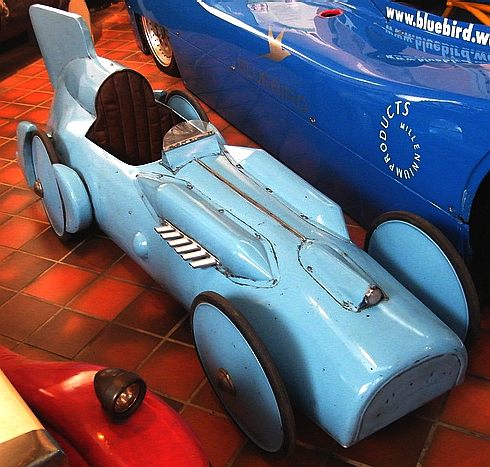
Back at Pendine on 21st July 1925 Campbell lifted his record to 150.766 mph becoming the first driver to exceed 150 mph. To commemorate this he had some large scale models of the Sunbeam built, at least two of which are known to have survived. This car is on display at the National Motor Museum in Beaulieu, England.
The following year Henry Segrave took Campbell's record and a knighthood in Sunbeam's monster twin-engined red 1,000 hp car which was also seen briefly at Brooklands driven by Henry in a wet but spectacular demonstration run. For the next ten years Campbell was to press on with another car, the Napier-Campbell which eventually took the land speed record at Utah in 1935 at 301.13 mph earning him his own long awaited knighthood. This car was rebuilt with newer and bigger engines on two separate occasions by Thomson & Taylor's and its full story is a testament to Campbell’s sheer gritty determination to succeed at almost any cost.
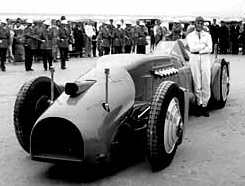
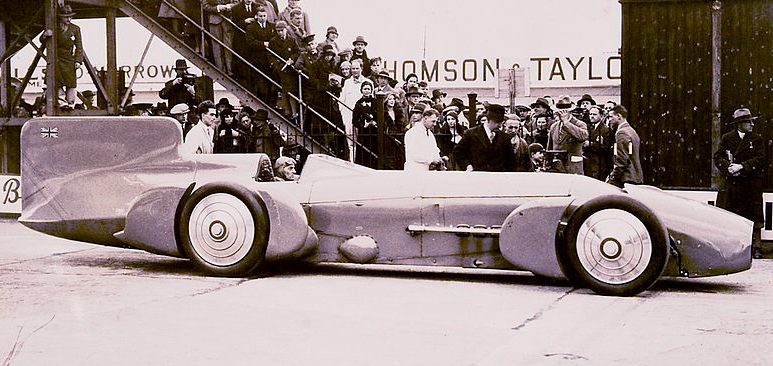
Left: Campbell at Pendine in 1930- Right: Railton's Bluebird 1931 - 1933 Daytona Beach
Throughout this period Campbell was very active in all classes of racing at Brooklands driving a 1½ litre Talbot, several Bugattis and the ex-Benoist straight eight supercharged G.P. Delage which was at the height of its fame in 1928 after numerous 1927 Grand Prix victories by its sister cars. In this car he dominated the 1928 200 Mile Race on 21st July, winning by 12 mins. 12 secs. at an average speed of 78.34 m.p.h.
Malcolm Campbell was a shareholder in Brooklands and very active in the running of the track, designing the Campbell road racing circuit within the confines of the site, which was used from its opening on 1st may 1937 to the outbreak of war.
1927
1929
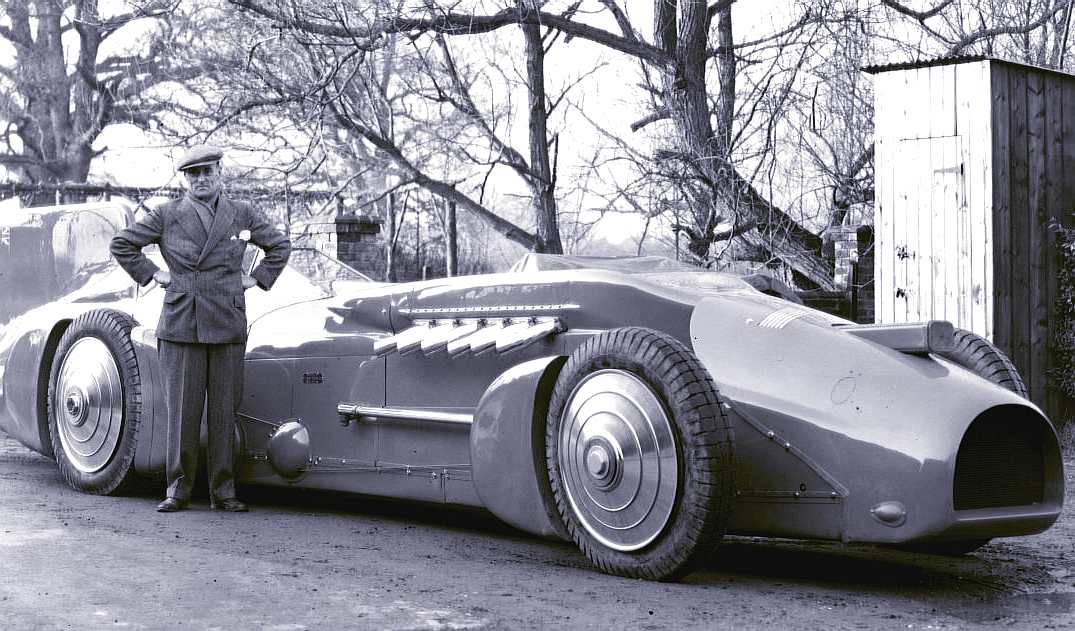
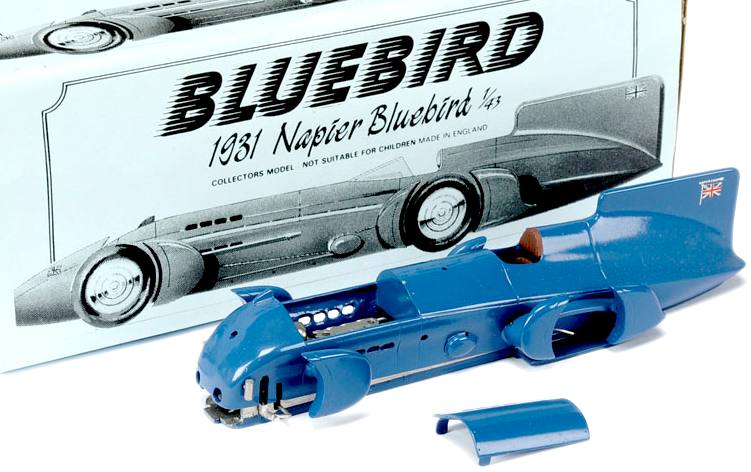
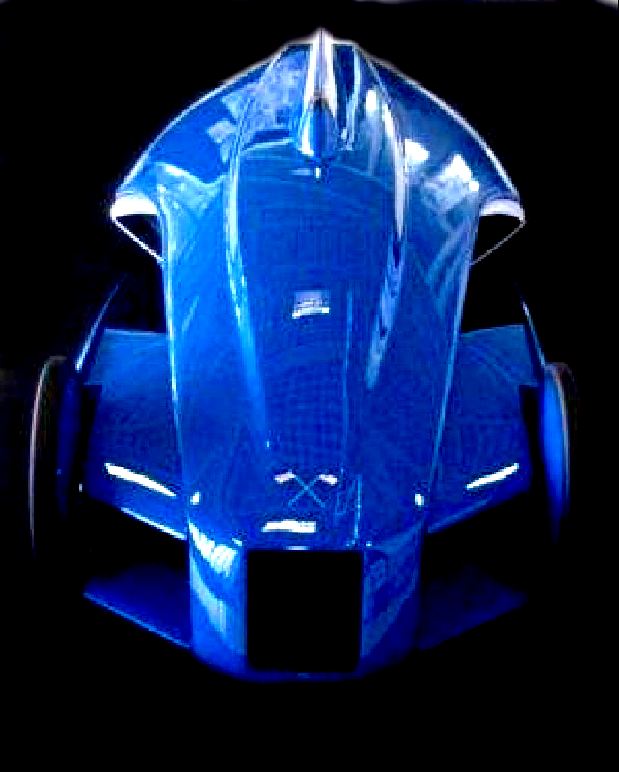
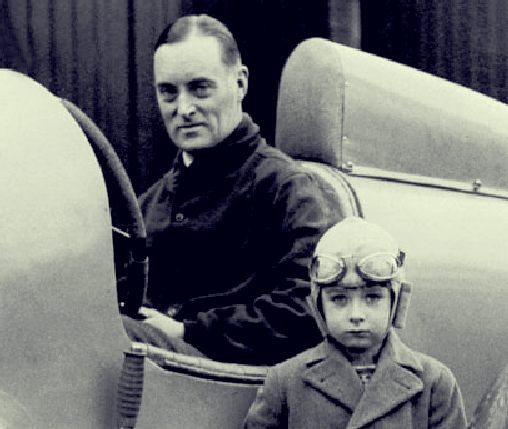
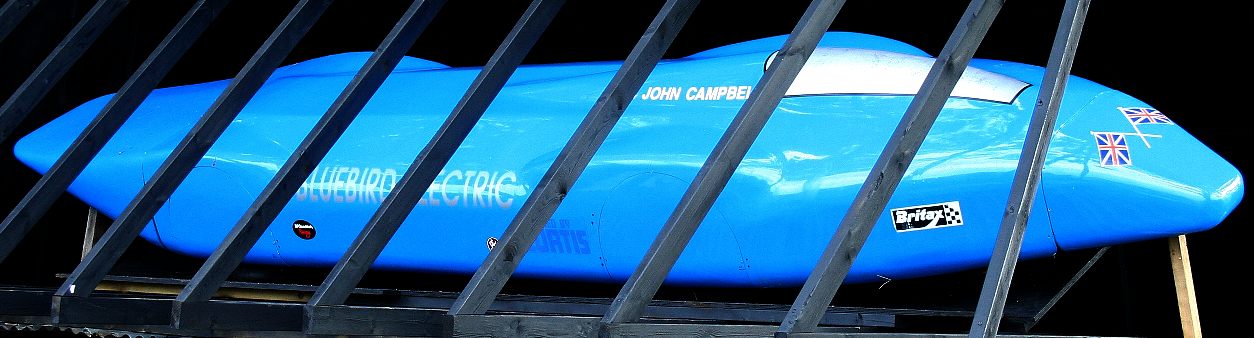
Rolls Royce engined Bluebird Napier from 1931, collectors model of the same and a concept car apparently inspired by the famous vehicle, in turn inspiring young Donald, pictured below with his father at the wheel - where else.
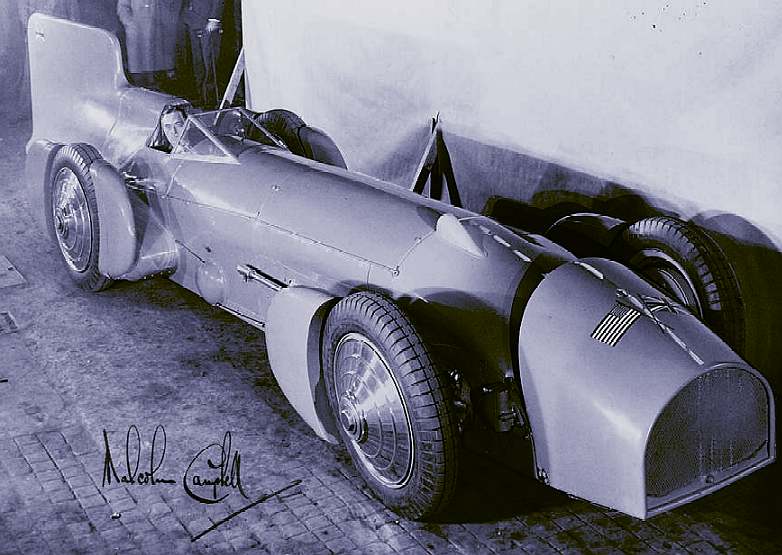
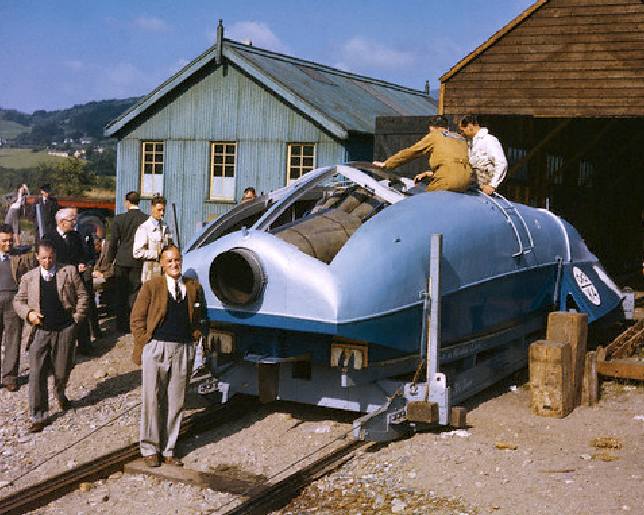
The Campbell-Napier-Railton Blue Bird was a land speed record car driven by Malcolm Campbell.
After Henry Segrave's Golden Arrow, clearly a more powerful engine was required for Blue Bird, with a chassis and transmission to handle it. A supercharged Napier Lion VIID was used, with over three times the power of the previous Blue Bird and a large premium over Golden Arrow's unsupercharged 900 hp (670 kW) Lion VIIA. This was the first use of supercharging for Land Speed Record cars. Golden Arrow's innovative vertical aerodynamic stabilising fin was also used, a first for Campbell.
The Campbell-Railton Blue Bird was Sir Malcolm Campbell's final land speed record car.
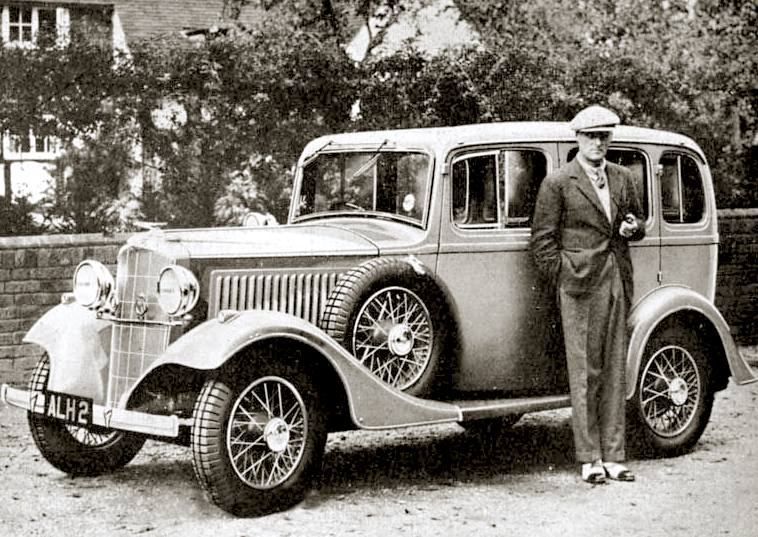
Malcolm Campbell had ties with Vauxhall
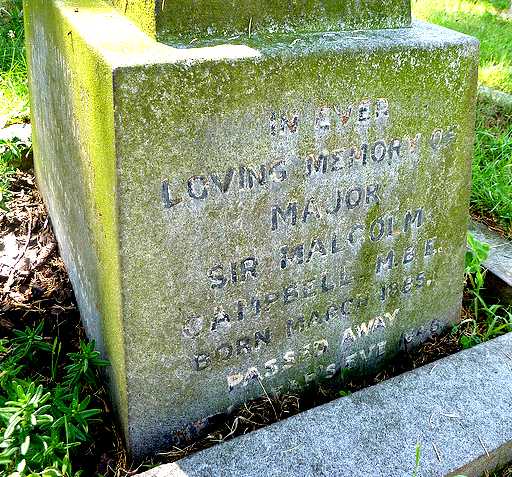
Malcolm Campbell died after a long illness in 1949 at the age of 64 and was succeeded by his son Donald who continued the record breaking tradition, breaking 400 m.p.h. in the turbine powered Bluebird CN7 which now resides in Lord Montagu’s National Motor Museum at Beaulieu. His Grandson Don Wales is a world record contender in the electric vehicle category.
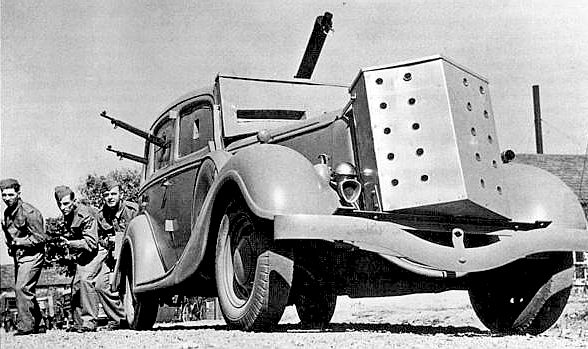
When Sir Malcolm Campbell was the provost company commander of the 56th London Division, Home Defence Force, he designed and then built the prototype of the Dodge armoured car which was unofficially known as the "Malcolm Campbell" car. Seventy of these were built by Briggs Motor Bodies of Dagenham and were ready by the end of August 1940. To increase the firepower of these cars and trucks, the Home Guard would often fit captured German machine-guns from crashed bombers to their vehicles, the only problem being fresh supplies of ammunition! Some units managed to get hold of a few World War I 6pdr tank guns and fitted them to the Malcolm Campbell cars.
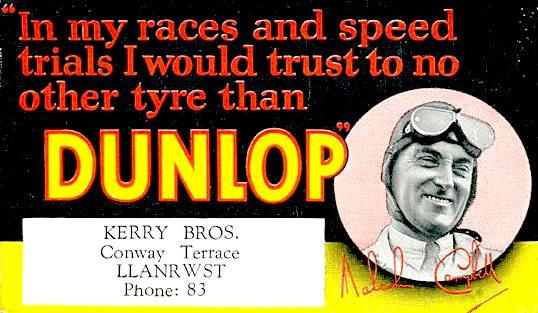
DUNLOP BLOTTER PROMOTIONS - This example was destined for Kerry Bros, of Conway Terrace, Llanwrst, a small town nestled in the Conwy Valley alongside the banks of the River Conwy in North Wales. There's no business of that name existing in Llanwrst now, although Conwy Terrace is still listed. The closest match find in the RAC Handbook (1959 issue) is for Jones Bros, of Kerry Garage. Is this the same company? A copy of the Handbook for 1928/1929 mentions Jones & Wight, of Central Garage, but nothing else, although of course Kerry Bros could have been there, but not running with RAC accreditation. Sir Malcolm Campbell was born in 1885, and gained fame thanks to his numerous speed record attempts, on both land and water, in a variety of machines. The first vehicles were called Blue Bird, later simplified to Bluebird. An account of Malcolm Campbell's 1927 Blue Bird is recalled in a contemporary issue of The Nelson Lee Library. Malcolm's taste for speed began in 1906 when he started competing in town-to-town motorcycle races, before switching to four-wheeled automobile races at Brooklands in 1910. Following WW1 he continued his high-speed exploits, capturing the land speed record in 1924 on Pendine Sands in South Wales, the first of nine speed records he'd claim over the following eleven years. Campbell was knighted in 1931, suggesting that the blotter above, which makes no mention of a title, pre-dates that occasion.
1939 - 1945
1947
He loved his cars, but he also loved boats and boating. The K4 jet powered Blue Bird boat was Sir Malcolm's last project in 1947, just two years before he died. A natural progression from the K3, this craft sports a rather fetching two-tone paint job.
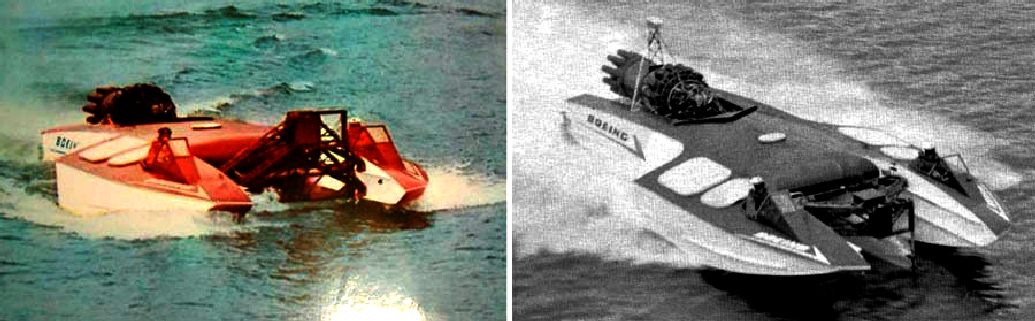
ENTER THE JET AGE - The gas turbine version of the K4 set the scene for the K7 of his son, Donald Campbell, where the general layout is the same. Ten years later in 1959, Boeing copied the concept in producing their Aquajet hydroplane, seen below. Time and again, small private enterprise leads the way with the military dragging their heels leaving a respectable mourning period, after which they think it is safe for them to adopt the latest technology - and not have to pay for the idea. The only time this changes is in time of war, when the military finally put their operation in gear.
AQUAJET - In 1959, Boeing began their research and development of hydrofoils. The hydrodynamic test system (HTS), called the Boeing "Aqua-Jet," was launched in 1961. It was a dual-cockpit jet-powered hydroplane that served as an aquatic version of a wind tunnel. Powered by an Allison J-33 jet engine, the HTS was designed to provide a level and stable platform for straightaway runs of up to 132 knots (115 mph/185 kph). A controllable fixture mounted between two prows held models of hydrofoils in the water during the test runs. You may be forgiven for thinking that the AquaJet looks very like the K7 Bluebird, because it does. It uses the same general configuration and same mounting location for its jet engine.
SUMMARY and EXTERNAL LINKS:
Sir Malcolm Campbell (born March 11, 1885 in Chiselhurst, Kent, England - died December 31, 1948) gained the world speed record on Land and on Water at various times during the 1920s and 1930s using vehicles called Bluebird. His son, Donald Campbell, was killed, attempting to repeat his achievements thirty years later.
On September 3, 1935 Malcolm Campbell reached 304.331 miles per hour on the Bonneville Salt Flats in Utah, becoming the first person to drive an automobile over 300 MPH.
He also competed in Grand Prix motor racing on the continent, winning the 1927 and 1928 Grand Prix de Boulogne in France driving a Bugatti T39A.
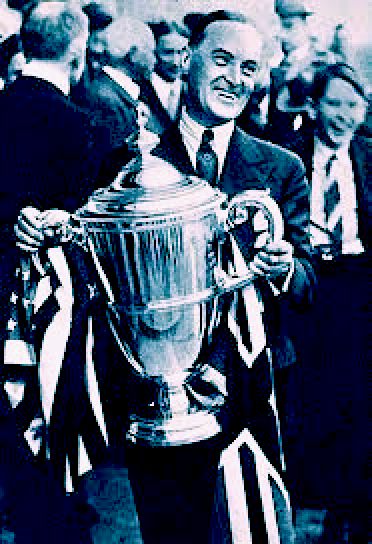
Sir Malcolm was inducted into the International Motorsports Hall of Fame in 1990. He collected numerous trophies during his career, many of which are now in private collections where the family heirlooms appear to have been sold off at various times, rather than jealously guarded.
HERITAGE TRUST
The Malcolm Campbell Heritage Trust is (according to Donald Wales) a body set up by family members in the 2000s to seek to preserve what they may of Sir Malcolm. Exactly what they are seeking to put into trust is not known. We do not know if there is a collection or museum that is operated by this trust, what they own and don't own. If you have any information of projects please let us know.
CAMPBELL MEMORABILIA AUCTIONS
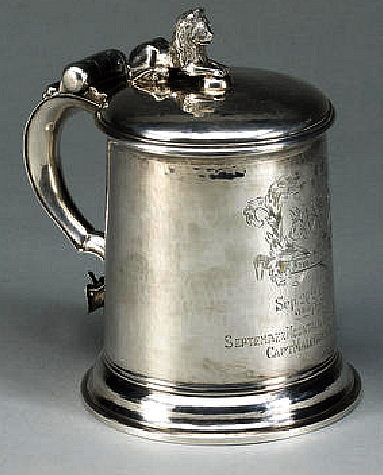
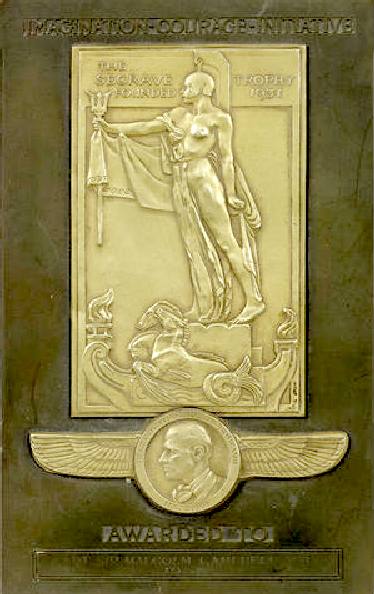
SEGRAVE TROPHY
Collectors' Motor Cars and Automobilia
Chichester, Goodwood
BROOKLANDS HANDICAP TROPHY 1930
The Motor Sports Association
(MSA) is recognised as the sole motor sport governing body for the United Kingdom by the world governing body, the Fédération Internationale de l'Automobile
(FIA). However many popular short circuit motorsport disciplines in the UK are not covered, such as Banger Racing, Autograss and Hot Rod Racing.
SIR
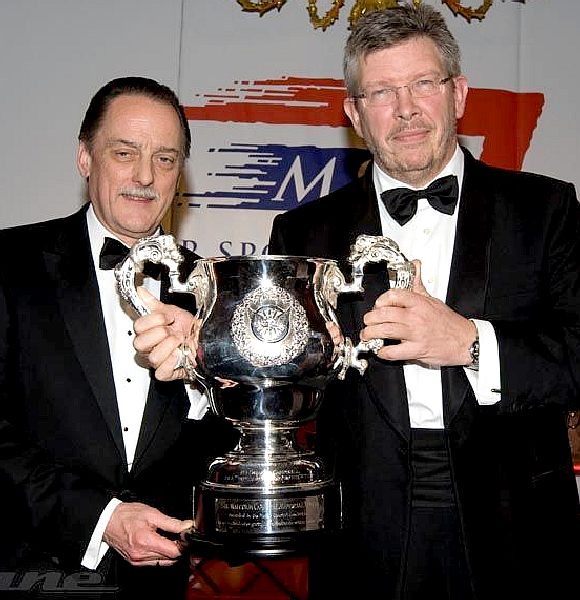
MALCOLM CAMPBELL MEMORIAL TROPHY - 22 FEB 2010
Brawn
is quoted as saying: 'It is with great pride that I accept this award on behalf of the whole team. Everyone worked extremely hard just to get us onto the grid in
Australia and then during the season to keep us ahead of the chasing pack. This award is due recognition for all the efforts of an amazing team of people and I am delighted to receive it on their behalf.'
Jack Brabham Jim Clark Mike Hawthorn James Hunt Sir Stirling Moss
Following a break in the awards, the trophy was then awarded in 1997 to the then-Squadron Leader Andy Green for driving Thrust SSC to the land speed world record of 763mph. It has been said that the Sir Malcolm Campbell Memorial Trophy will from 2010 be awarded annually by the Motor Sports Association to an individual or group for excellence within motor sport. Here, here.
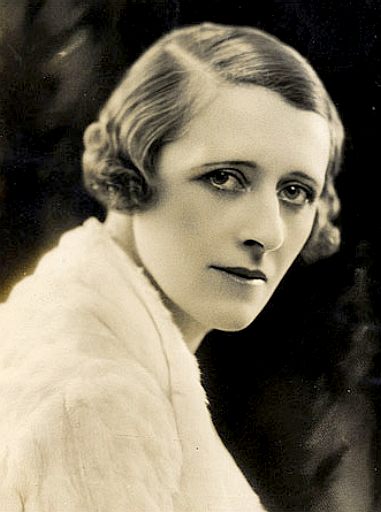
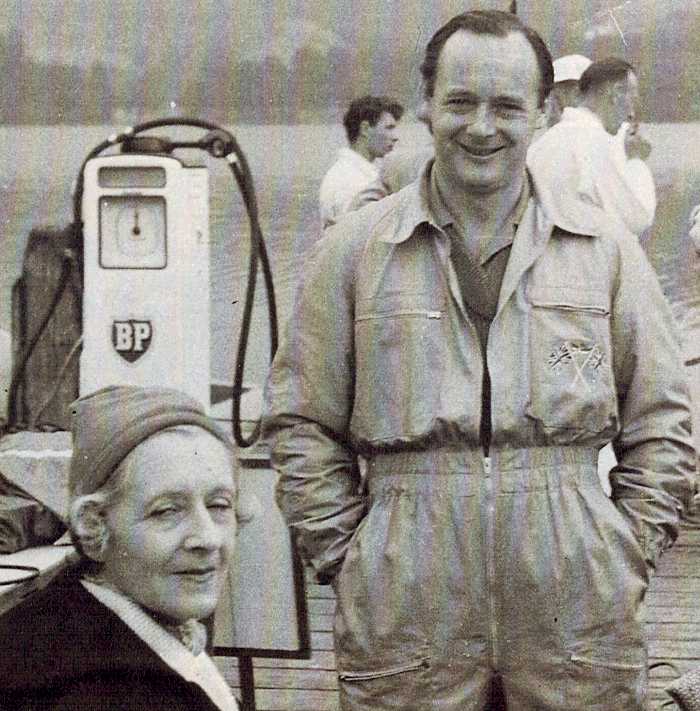
Sir Malcolm and Lady Dorothy Campbell above had a son and a daughter. Donald is well known for his speed records. Jean Dorothy Wales (nee Campbell) is lesser known. Her son Donald, is now better known as Don Wales. Jean and Donald are pictured below. She is recorded as living at Orchard Lodge, Oakhurst Lane, Loxwood in West Sussex, at the time of the making of a Declaration of Trust dated the 16th of October 2001 - this Declaration was made in connection with the setting up of the Malcolm Campbell Heritage Trust, a Trust that appears to have been set up to create a fund in furtherance of the projects (objects) of both Malcolm and Donald Campbell. A bit late in the day, but not a bad idea - actually triggered by the efforts of Bill Smith, the diver who raised the K7 early in 2001.
ART LINKS
WW2 vehicles home front guard militia - Dad's Army http://www.war44.com/home-front/2307-vehicles-used-home-front.html Bonhams auctions sale 14259 lot 496 Bonhams auctions sale 18213 lot 238 http://www.bonhams.com/auctions/14259/lot/496/ http://www.bonhams.com/auctions/18213/lot/238/ Arthur Benjamins - http://www.bluebirdpublications.co.uk/
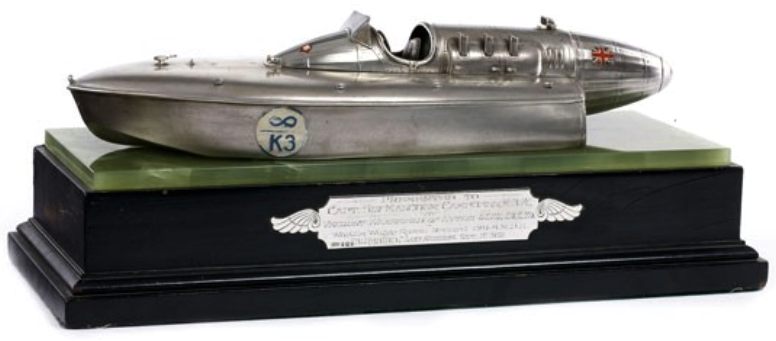
A trophy does not have to be a cup. It can be anything representative of the event's objectives, such as the K3 water speed record boat for the Bluebird trophy presented to Malcolm Campbell when he broke the world water speed record, hitting the new world record speed of 126.33mph on Lake Maggiore in Switzerland on 1 September 1937.
Sir Charles C Wakefield (Lord Wakefield of Hythe 1859-1941) Was the principal Director of CC Wakefield & Co. Ltd. , the "Castrol" oil company. A keen supporter of motor and aviation development, he was the sponsor of Amy Johnson's flight to Australia and he partner Capt.James Mollison's attempt on the Atlantic. He sponsored Sir Henry Segrave's attempts in Miss England lll to recapture the British International Trophy, but stepped back from the field following Segraves death in 1930. However, he supported Sir Malcolm Campbell in both his land and Waterspeed record attempts and made several presentations to Campbell to commemorate notable records.
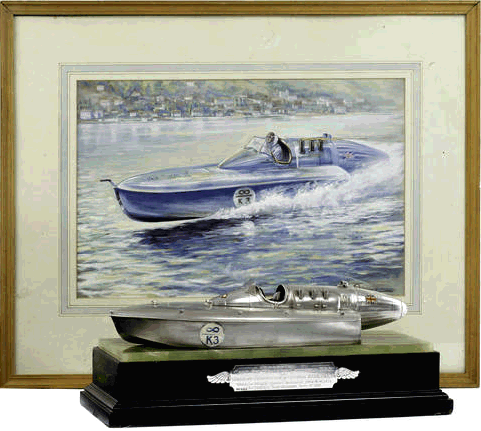
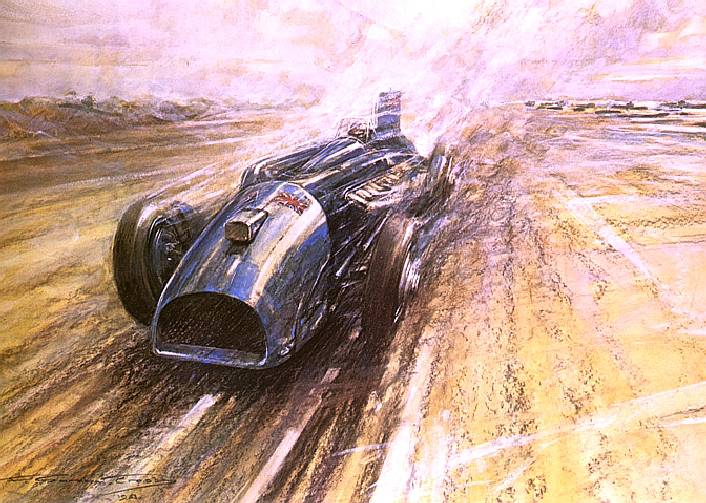
[Left] BONHAMS AUCTION 2010 - The trophy, a model of the single-step hydroplane Bluebird K3, attracted a pre-sale price of £35,000 to £50,000 ahead of the Bonhams auction on 24 March 2010. An outstanding waterline model of Sir Malcolm Campbell's single step hydroplane K3 set onto a green onyx base, on a black wooden plinth with a silver plaque inscribed "Presented to Capt. sir Malcolm Campbell, MBE. by Viscount Wakefield of Hythe GCVO, CBE, TD. World Water Speed Record 129.5 mph Bluebird, Lake Maggiore. Sept. 1st 1937". Hallmarked London 1937 by Skinner & Co. Together with a watercolour by Raymond Groves of K3 on Lake Maggiore, formerly the property of Sir Malcolm Campbell, measuring 19.3x8x7in (49x20x18cm). [Right] Gordon Crosby LSR artwork is somewhat Turneresque in our view.
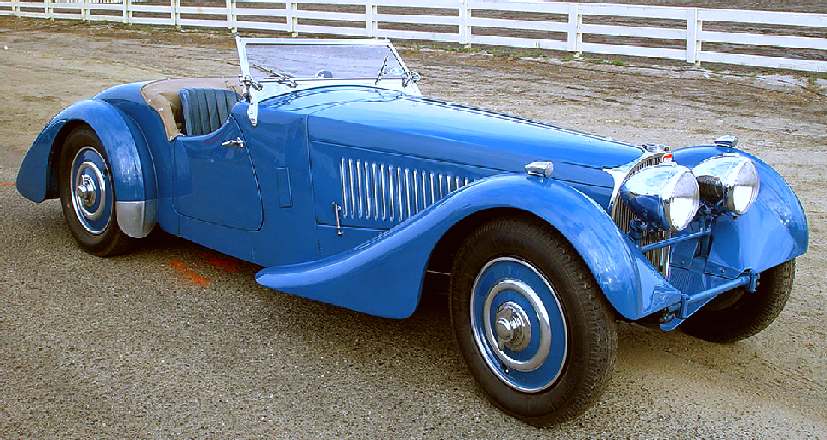
Thought to have been the property of Sir Malcolm Campbell, the 1935 Bugatti above (chassis 57531) is one of the most original Type 57SC's - held not to have been restored. According to web reports the body had not been off the frame and most of the paint is original. Incredible. The car was ordered by Sir Malcolm Campbell of England then sent un-bodied to Corsica of London. After the coachwork was completed it was painted blue and nicknamed - you guessed it: 'Blue Bird'.
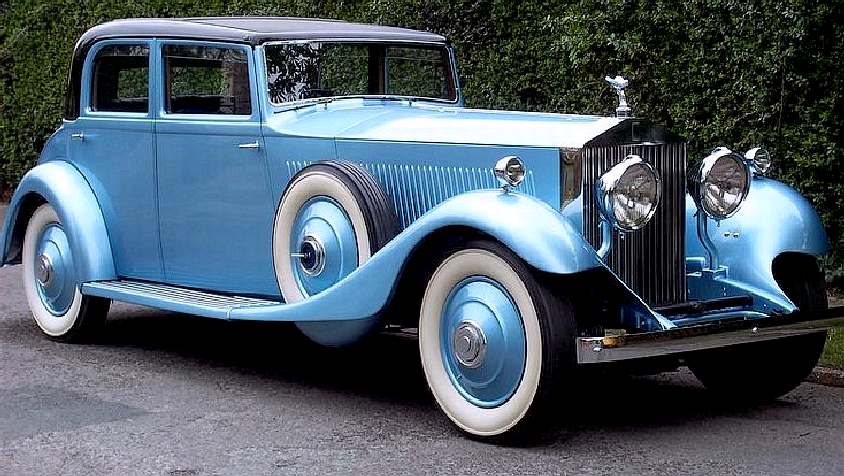
Sir Malcolm Campbell's 1933 Rolls Royce Phantom II seen here in a stunning, what looks to be a, pearl metallic blue paint job. That sort of paint mix may not have been available in 1933, but the custom finish is superb.
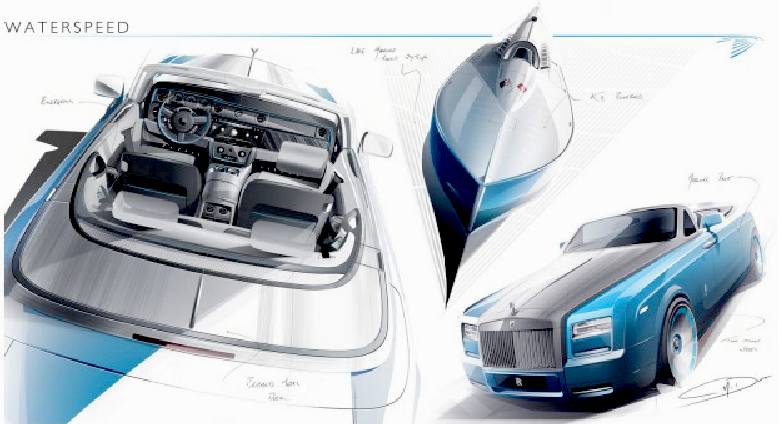
Rolls Royce Phantom "Waterspeed" commemorative edition drophead coupe. This special limited run of custom cars is dedicated to Sir Malcolm Campbell and the famous K3. The Rolls-Royce Phantom Drophead Coupé Waterspeed Collection was previewed to selected UK press and customers at an exclusive event on the site of the original Bluebird Motor Company – now the Bluebird Restaurant – on the King’s Road, London on Tuesday 13 May 2014.
SIR MALCOLM CAMPBELL'S BLUE BIRDS
DONALD CAMPBELL'S BLUEBIRDS
Jetstar (not a bluebird)
LEGENDARY - The blue bird legend continues with the classic lines of this racing car, inspired by Reid Railton and his designs for the Napier Lion and Rolls Royce engined Blue Bird LSR cars in the 1930s. The Blueplanet BE3 features instant battery recharging using the patent Bluebird™ cartridge exchange system under license from BMS. This LSR is also solar assisted. She is designed for speeds in excess of 350mph using clean electricity. Imagine the spectacle of this beautiful vehicle speeding across the salt at Bonneville, or flying past on the sand at the Daytona or Pendine beaches. To hire this vehicle for your venue please contact BMS and ask for Richard or Terry. The BE3 team need at least 6 months advance notice of events or the fees rise dramatically.
UK VEHICLE INSURANCE ONLINE A - Z
We all need insurance. No matter what car, van or bike you drive, we're all looking for great value and quality in your UK motor insurance? But who is the best - who is the cheapest and who offers the great service in the event of a claim?
SIR
MALCOLM CAMPBELL LAST WILL & TESTIMONY
|
|||||||||||||||||||||||
|
This
website is Copyright © 2017 Bluebird Marine Systems Limited.
The names Bluebird, Bluefish,
SeaVax™, and the blue bird in flight
|
|||||||||||||||||||||||