|
The First World War (1914-18)
brought permanent change to Brooklands in many ways. Motor Racing was discontinued
for the duration of the war but the solid tyres of military lorries
played havoc with the Track, and it was not until 1920 that Locke King had
cleaned up sufficiently to enable the BARC to take over once again.
Brooklands came alive again in 1921. This saw the first of the Junior Car
Club's 200 mile races. Pre-war driver, Malcolm Campbell, returned to the
scene from Army service as a Captain. The race was a great success. The
winner was Major Henry Segrave, another famous driver of the day.
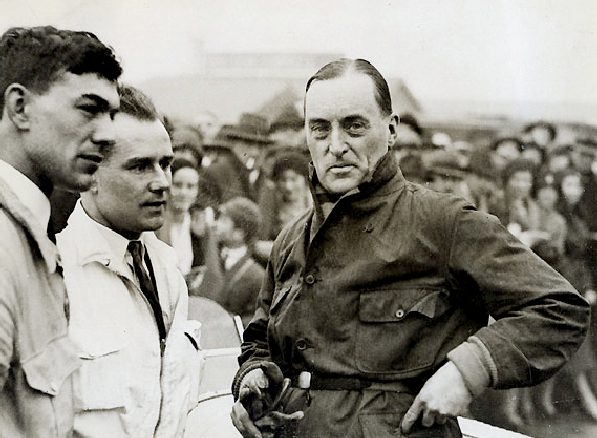
Leo
Villa (middle) and Captain
Campbell (right) at Brooklands in 1931
Then in 1926, the RAC organised the first-ever British
Grand Prix. Special sand chicanes and a hazardous bridge across the Finishing
Straight were constructed. The same layout was adopted for the Junior Car
Club 200 mile race later that year. Again, the race was won by Major Henry
Segrave in a Talbot. The same year Hugh Locke King died but Ethel, now a
Dame of the British Empire in honour of her work in the Red Cross during the
war, continued active management of the Brooklands Estate. She also regularly
attended Race meetings.
The last Land Speed Record achieved at Brooklands was when Kenelm Lee
Guinness,
a member of the famous brewing family, drove the 350hp single seater Sunbeam at
a two-way average speed of 135.75mph. This car, powered by a V12 Sunbeam
'Manitou' aero engine was soon after acquired by Malcolm Campbell and became his
first 'Blue Bird'
Land Speed Record Car. Count Louis Zborowski was one of the great
personalities of Brooklands and raced a series of monstrous cars on the Outer
Circuit, including the legendary Chitty Bang Bangs, in the early 1920s.
Based in their Brooklands workshops, Thomson & Taylor went on to design and
build several Land Speed Record cars including three of Malcolm Campbell's Blue
Birds. It was Campbell that called in Reid Railton to re-design the chassis and
transmission of his 1931 Napier engined Blue
Bird. The body shape resulted from
testing in the Vickers aircraft factory's
Wind Tunnel at Brooklands supervised
by R.K. Pierson, Vickers' Chief Designer, as he had with Campbell's first
scientifically streamlined Blue Bird in 1928.
Reid
Railton - Bluebird
In 1933 Thomson & Taylor made more major changes to
accommodate a supercharged Rolls Royce 'R' type 36½ litre V12 engine giving
2,500 brake horse power. Campbell's ultimate Land Speed Record car was the
1935 Blue Bird using the same engine but a new chassis designed and built by
Thomson & Taylor at Brooklands. The body was built in the Paddock shed once
used by Malcolm Campbell as his showroom. In this car Campbell took his eighth
and final Land Speed Record on the 3rd September, 1935 on Bonneville Salt Flats
and achieved his longed for target, averaging 301.13mph.
By the end of the 1930s Brooklands was dominating the Land Speed Record in every
way with the exception of actually being the venue itself. Another Land
Speed Record Car simply called 'The Railton' was a technological masterpiece
designed by Reid Railton and built at Thomson & Taylor's Brooklands
workshops. It was commissioned and driven by the Brooklands ace, John Rhodes
Cobb, who took the Land Speed Record in it in 1938, 1939 and again in 1947 when
he became the first man to exceed 400 mph on land.
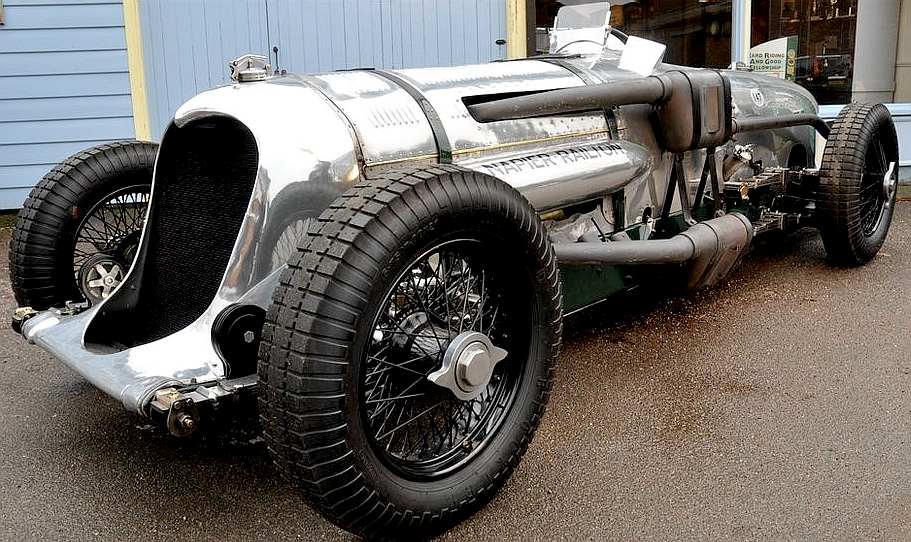
The Outer Circuit Record was the most prestigious. In 1930, The Daily Herald put
up a trophy for the fastest driver round the track. Up to 1935, this
trophy was
won by just 4 drivers, Kaye Don, the first winner, battled with Tim Birkin to
achieve 137.58mph in his Sunbeam 'Tiger'. In 1932, Tim Birkin took the record to
137.96mph in his famous red blower Bentley.
Why not visit Brooklands Adults £7,
Students & Senior Citizens £6 Children 6-16 £5, 5 & under get in FREE
Family ticket £18 (admits 2 adults & 3 children)
Brooklands Museum Trust Limited Brooklands Road, Weybridge,
Surrey KT13 0QN Tel: 01932 857381 Fax: 01932 855465
Email: info@brooklandsmuseum.com
LINKS
Mercedes-benz
world brooklands_museum
Brooklands
radio | Brooklands
hotel surrey
Historic
vehicles at Brooklands
Brooklands
Concorde | Wikipedia
Brooklands
Brooklands
University | Brooklands
http://www.brooklandsradio.co.uk/
http://www.brooklandshotelsurrey.com/
http://www.historics.co.uk/
http://www.brooklandsconcorde.co.uk/
http://en.wikipedia.org/wiki/Brooklands
http://www.brooklands.ac.uk/
http://www.brooklands.org.uk/
A
- Z OF WORLD FAMOUS RACING CIRCUITS
TAGS
|
Aintree
Autodromo
Hermanos Rodriguez
Autódromo
Internacional Nelson Piquet
Autódromo
José Carlos Pace
Bahrain
International
Barcelona-Catalunya,
Circuit de
Bathurst
Brands
Hatch
Bremgarten
Circuit
Brooklands
Donington
Park
Fuji
Speedway
Giles
Villeneuve
Goodwood
Hockenheimring
Imola
Indianapolis
Knockhill
Korea
International Circuit
|
Laguna
Seca
Le
Mans
Mallory
Park
Monaco
Monte
Carlo
Monza
Nurburgring
[Nordschleife] (Germany)
Oulton
Park
Rockingham
Santa
Pod Raceway
Sebring
International Raceway
Shanghai
International
Silverstone
Snetterton
Spa
Francorchamps
Suzuka
Circuit
Thruxton
Zandvoort,
Circuit Park
Zeltweg
|
Our 'Bluebird' trademark accurately
depicts the bird's colouration, twin tail feathers, beak and head shape. Many songs and
poems have been written about this lively little animal. The Bluebird
became immortalized in Maurice Maeterlinck's play:
'The Bluebird' which first
inspired Malcolm Campbell to adopt the name for his racing vehicles in the
1930's. The Bluebird name is one of the most popular for merchandising just
about every product, so too is the blue bird logo. Ours is unique and
the colour blue is a registered protected feature to prevent unlicensed
passing off.
One
of the most irksome worries for LSR designers, is that although they may
have begun a project in good faith, and we mean begun, as in put it all
together - getting paid for their efforts in a
hostile commercial environment can prove to be nigh on impossible where
other team members may have their own agendas brewing and old school
chum accountant pets to advise on strategy, such as to avoid settling sums
due - and more interestingly to prevent a talented designer from going
it alone: a war of attrition.
|
