|
US
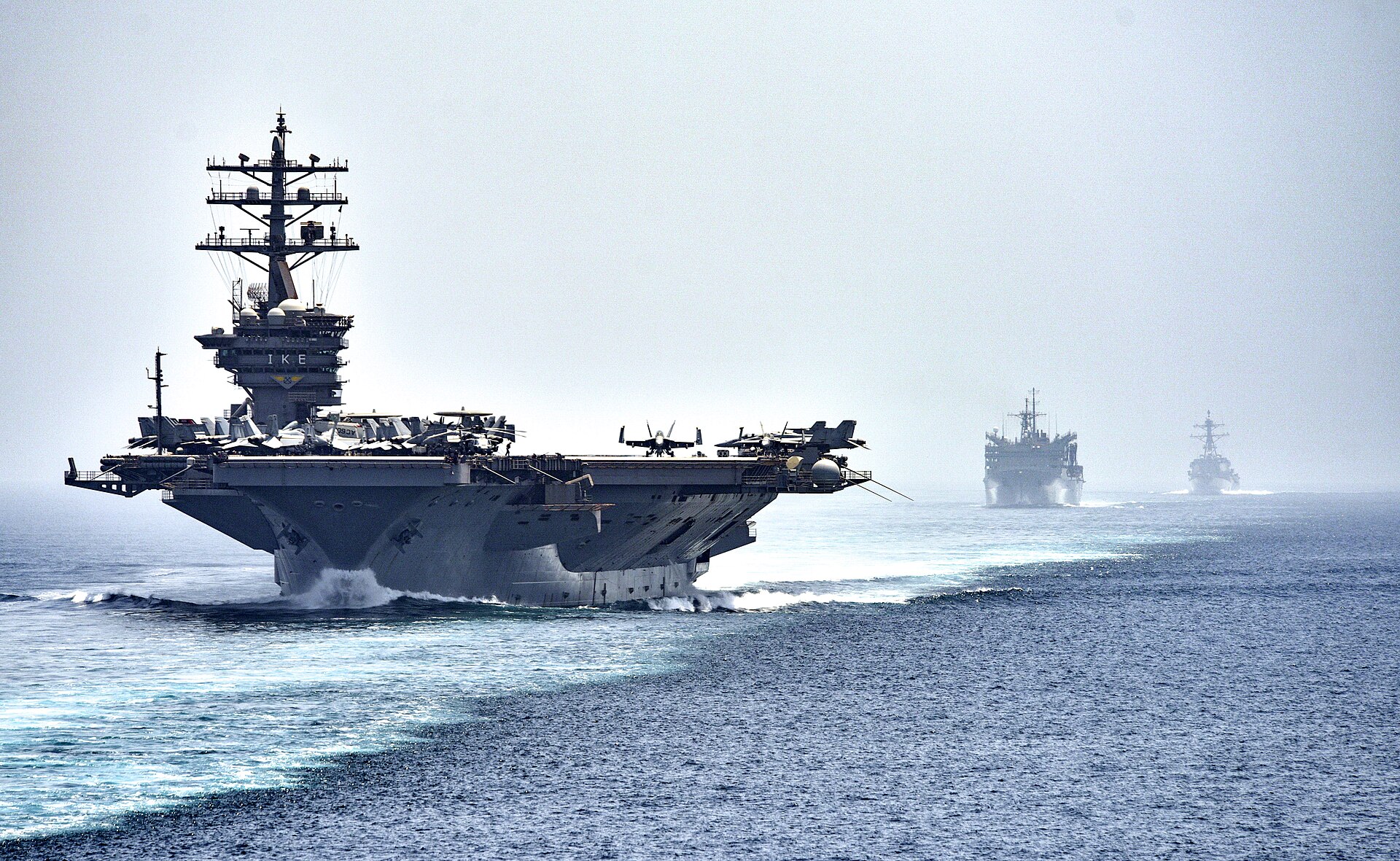
NAVY - Aircraft carrier in the Strait of Hormuz
2026 WAR
Before the 2026 Israeli–United States strikes on Iran, ship insurance for the strait increased from 0.125% to between 0.2% and 0.4% of the ship insurance value per transit. For very large oil tankers, this is an increase of a quarter of a million dollars. By 9 March, insurance rates were reported to have increased by four to six times over the previous week, and the U.S. government began to help insurers under the Terrorism Risk Insurance Act.
On 28 February 2026, amid the 2026 Iran war and after the assassination of Iranian supreme leader Ali Khamenei, Iran's Revolutionary Guards began issuing VHFTooltip very-high-frequency transmissions stating that ship passages through the Strait of Hormuz were "not allowed". Although the closure is not legally binding, military and industry sources say that safety cannot be guaranteed, and many ships stayed in port or turned back, while at least 17 oil tankers continued traveling through the strait.
On March 2, the Islamic Revolutionary Guard Corps officially confirmed that the strait of Hormuz was closed and that any ship that entered the strait was to be set on fire. This came after several reports of Iranian attacks on ships passing into the Strait of Hormuz. However, a few ships still passed the strait unharmed. The next day,
President Donald Trump stated that the U.S. Navy may escort oil tankers through the Strait of Hormuz.
On 12 March, three cargo vessels were hit in the Strait of Hormuz. This came on the same day as the release of 400 million barrels of oil announced by the International Energy Agency. It was also reported that Iran had deployed about a dozen mines in the Strait of Hormuz, halting the exports of
oil and LNG.
A
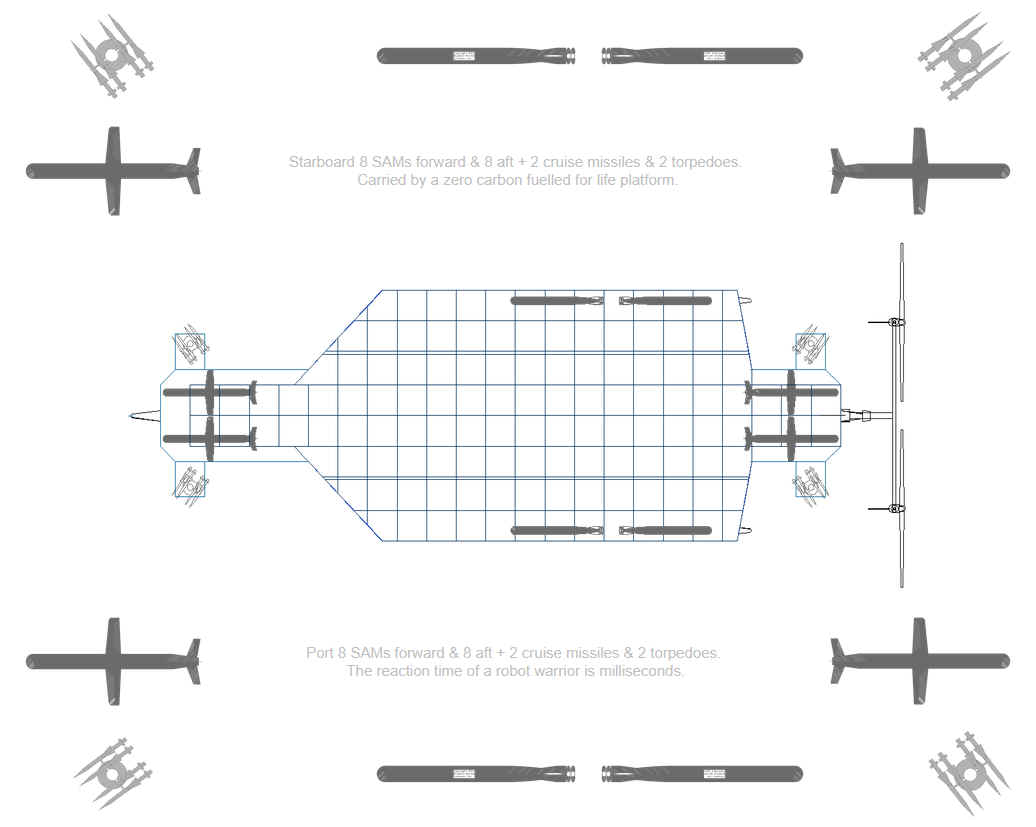
SeaWolf ZCC, robotic destroyer draft design from 2013
WOLVERINE
ZCC
To
help reduce the expense of convoys, and to track back missile and drone
attacks, the Wolverine
ZCC, or SeaWolf
system was proposed in 2013, with a patent granted for autonomous navigation
too late to make any real difference in NATO
and MOD
worlds. This would remain the case until the Russian war with Ukraine,
when drone warfare came into its own. When, suddenly the British Royal
Navy ordered small drone speedboats from Kraken Technology in
Portsmouth, in March of 2026. That was after the Frigate un-readiness
fiasco, embarrassed prime minister Kier Starmer. And the less said about Astute
submarines, the better. £Billions
of taxpayer's money wasted, and that includes the Elizabeth
class aircraft carriers.
The
fact is that the United Kingdom could have been ahead of the game, but
that the senior service is traditionally slow on the uptake, as with the propeller
and steam
turbine. Parliament needs to be dragged to the trough, kicking and
screaming, in order to disturb procurement payments to favoured
subcontractors. A sad fact their enemies are sure to exploit, during
hostilities. Dear old Winston
would turn in his grave: "Speak softly, but carry a big stick."
The
concept is more aimed at peacekeeping duties, an effort to contain the
price of policing politically sensitive waters.
IRAN'S ABILITY TO HINDER OIL TRANSPORTS
Millennium Challenge 2002 was a major war game exercise conducted by U.S. armed forces in 2002. It simulated an attempt by a country (likely to be Iran) to close the strait. The assumptions and results were controversial. Iran's simulated strategy beat the materially superior U.S. armed forces.
A 2008 article in International Security contended that Iran could seal off or impede traffic in the strait for a month, and an attempt by the U.S. to reopen it would be likely to escalate the
conflict. In a later issue, however, the journal published a response which questioned key assumptions and suggested a much shorter timeline for re-opening.
Moreover, due to Iran's own dependence on oil exports through the strait as well as imports, (due to its inability to refine oil on its own) a closure of the strait is unlikely. Not only Iran's own dependence on the strait for imports and exports is indicative that a prolonged closure is unlikely, but also the dependence of its allies on the trade that flows through it suggest the logistical infeasibility of such closure. A neoclassical-realist analysis describes Iranian policy regarding the strait as "double-faced": in non-existential threat environments Tehran tends to act as a security provider by keeping the strait open, whereas under threats perceived as existential it takes calculated risks and incorporates the waterway into a wider deterrence and brinkmanship strategy.
This interpretation portrays Iran as a reactive actor that employs interference or brinkmanship to gain concessions and trigger de‑escalatory measures from the international community. This literature also emphasizes that Iran’s strategy with respect to the strait is constrained by its own reliance on the waterway, that of key partners, material limits and sanctions, which lowers its freedom to take risks and suggests that any prolonged closure would be particularly damaging for Iran itself and its allies.
In December 2011, Iran's Navy began a ten-day exercise in international waters along the strait. Iranian Rear Admiral Habibollah Sayyari stated that the strait would not be closed during the exercise; Iranian forces could easily accomplish that but such a decision must be made at a political level. Captain John Kirby, a Pentagon spokesman, was quoted in December 2011 saying: "Efforts to increase tension in that part of the world are unhelpful and counter-productive. For our part, we are comfortable that we have in the region sufficient capabilities to honor our commitments to our friends and partners, as well as the international community." Suzanne Maloney, an expert at the Brookings Institution, said, "The expectation is that the U.S. military could address any Iranian threat relatively quickly." General Martin Dempsey, Chairman of the Joint Chiefs of Staff, said in 2012 that Iran "has invested in capabilities that could, in fact, for a period of time block the Strait of Hormuz." He stated, "We've invested in capabilities to ensure that if that happens, we can defeat that."
A May 2012 article by Nilufer Oral, a Turkish researcher of maritime law, concludes that both the UNCLOS, which came into effect in 1994; and the 1958 Convention on the High Seas would be violated if Iran followed through on its threat to block passage of vessels, such as oil tankers, and that the act of passage is not related in law to the imposition of economic sanctions. The article further asserts that a coastal state may prevent "transit or non-suspendable innocent passage" only if: 1) there is threatened or actual use of force, occurring during passage, against the sovereignty, territorial integrity, or political independence of a state bordering the strait; or 2) the vessel in any other way violates the principles of international law as embodied in the Charter of the
United
Nations.
As of 2013, the UNCLOS treaty had been ratified by 63 states, including most NATO-bloc and Soviet-bloc nations but with the notable exceptions of most of the OPEC and Arab League nations like Syria, Egypt, Jordan, Saudi Arabia, and Iran, as well as China, North Korea, and South
Korea. As of February 2026, 157 sovereign states, including the EU are parties, including all major powers except the United States, which has not ratified the treaty.
GEOGRAPHY
The Strait of Hormuz is a strait between the Persian Gulf and the Gulf of Oman. It provides the only sea passage from the Persian Gulf to the open ocean and is one of the world's most strategically important choke points. It has been so for centuries, with vast hinterlands rich in luxury trade goods, but no easy access to lucrative trading ports. In his memoirs, Babur, the first padishah of the Mughal Empire, recounted how almonds had to be carried from the distant Ferghana region in Central Asia to Hormuz to reach markets.
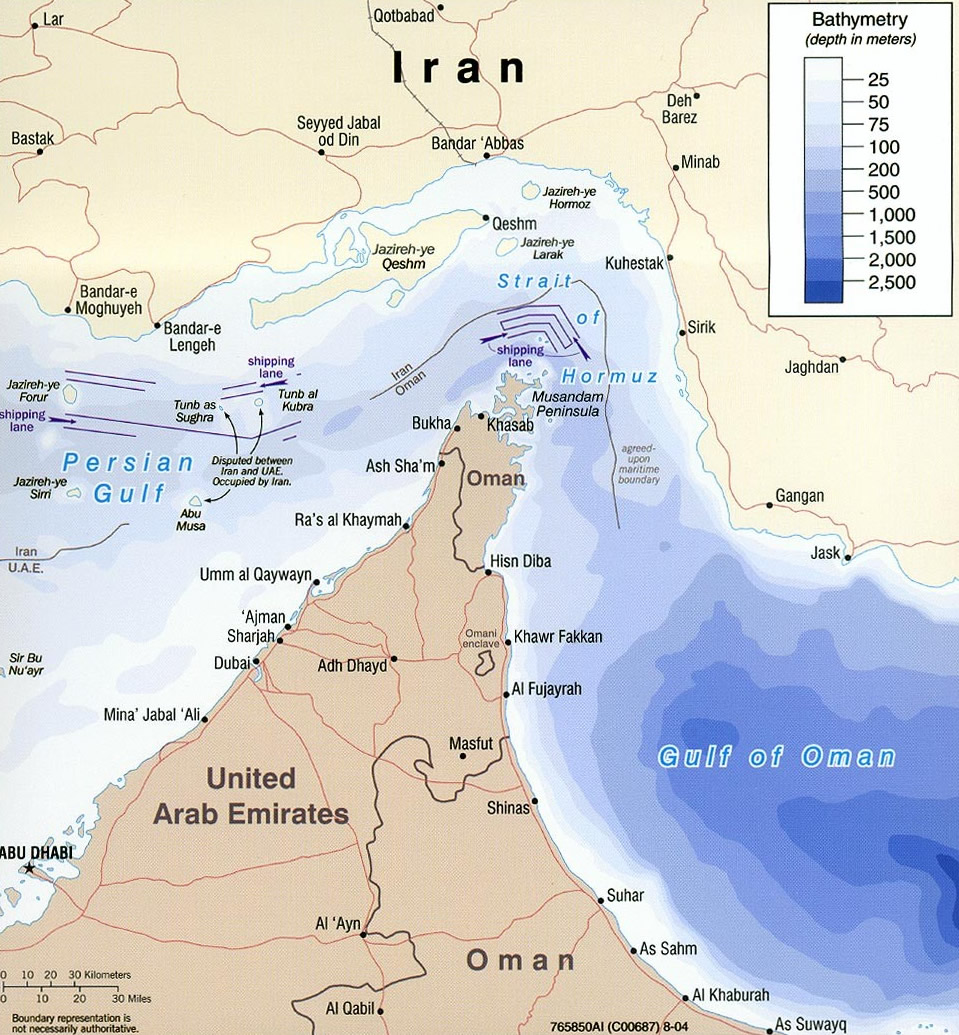
On the north coast lies Iran, and on the south coast lies the Musandam Peninsula, shared by the United Arab Emirates and the Musandam Governorate, an exclave of Oman. The strait is about 104 miles (90 nmi; 167 km) long, with a width varying from about 60 mi (52 nmi; 97 km) to 24 mi (21 nmi; 39 km).
During 2023–2025, 20% of the world's liquefied natural gas (LNG) and 25% of seaborne
oil trade passed through the strait annually. The strait had never been closed for extended time during Middle East conflicts (unlike the Straits of Tiran/Bab-el-Mandeb) though Iran occasionally had threatened to close the strait, and preparations to mine it have been undertaken.
NAVIGATION
To reduce the risk of collision, ships moving through the strait follow a traffic separation scheme (TSS): inbound ships use one lane, outbound ships another, each lane being two miles wide. The lanes are separated by a two-mile-wide "median".
To traverse the strait, ships pass through the territorial waters of Iran and Oman under the transit passage provisions of the United Nations Convention on the Law of the Sea (UNCLOS). Although not all countries have ratified the convention, most countries, including the U.S., accept these customary navigation rules as codified in the convention.
In 1959, Iran altered the legal status of the strait by expanding its territorial sea to 12 nmi (22 km) and declaring it would recognize only transit by innocent passage through the newly expanded area. In 1972, Oman also expanded its territorial sea to 12 nmi (22 km) by decree. Thus, by 1972, the Strait of Hormuz was completely "closed" by the combined territorial waters of
Iran and Oman. During the 1970s, neither Iran or Oman attempted to impede the passage of warships, but in the 1980s, both countries asserted claims that were different from customary (old) law. Upon ratifying UNCLOS in 1989, Oman submitted declarations confirming its 1981 royal decree that only innocent passage is permitted through its territorial sea.
The declarations further asserted that prior permission was required before foreign warships could pass through Omani territorial waters. Upon signing the convention in 1982, Iran entered a declaration stating "that only states parties to the Law of the Sea Convention shall be entitled to benefit from the contractual rights created therein", including "the right of transit passage through straits used for international navigation". In 1993, Iran enacted a comprehensive law on maritime areas, provisions of which conflict with UNCLOS provisions, including a requirement that warships,
submarines, and nuclear-powered ships obtain permission before exercising innocent passage through Iran's territorial waters. The U.S. does not recognize any of the claims by Oman and Iran and has contested each of them.
OIL TRADE FLOWS
During 2023–2025, 20% of the world's liquefied natural gas and 25% of seaborne oil trade passes through the Strait, illustrating its important location for trade.
According to the U.S. Energy Information Administration, in 2011, an average of 14 tankers per day passed out of the Persian Gulf through the strait carrying 17 million barrels (2,700,000 m3) of crude oil. More than 85% of these crude oil exports went to Asian markets on a daily basis, with Japan, India, South Korea and China the largest destinations. In 2018, 21 million barrels a day passed through the strait, worth $1.2 billion at 2019 prices.
If shipping through the Strait of Hormuz were significantly disrupted for an extended period, it could lead to a major
oil supply crisis for major Asian importers such as
India and
China.
Map
of the UAE, Gulf of Oman, Persian Gulf and Strait of Hormuz
ACIDIFICATION
- ADRIATIC - AEGEAN
- ARCTIC
- ATLANTIC - BALTIC
- BAY BENGAL - BAY
BISCAY - BERING
- BLACK - CARIBBEAN - CORAL
- EAST CHINA - ENGLISH
CH -
FINLAND - GOC
- GULF GUINEA - GULF
MEXICO - GULF THAILAND - GULF
TONKIN - HORMUZ - INDIAN -
IONIAN
- IOC
-
IRC
- IRISH
- MEDITERRANEAN - NORTH
SEA - PACIFIC - PERSIAN
GULF
RED
SEA - SEA JAPAN
- STH
CHINA - PLASTIC
- PLANKTON - PLASTIC
OCEANS - RED - SARGASSO
- SEA
LEVEL RISE - SOUTHERN
OCEAN - TYRRHENIAN
- UNCLOS
- UNEP
WOC
- WWF
AMAZON
- BURIGANGA - CITARUM -
CONGO -
CUYAHOGA
-
GANGES - IRTYSH
- JORDAN -
LENA -
MANTANZA-RIACHUELO
MARILAO
- MEKONG -
MISSISSIPPI -
NIGER -
NILE -
PARANA -
PASIG -
SARNO - THAMES
- YAMUNA -
YANGTZE -
YELLOW -
ZHUJIANG
LINKS
& REFERENCE
http://
FICTION
- Operation
Neptune - An
advanced nuclear submarine is hijacked by environmental extremists intent on
stopping pollution from the burning of fossil fuels. The extremists torpedo a
number of oil wells as part of a campaign to cause energy chaos, with bigger
plans to come. If you enjoyed
Battleship,
Under Siege or
The Hunt for Red
October, this is a
must for you.
|