|
BRITISH INTERNATIONAL HARMSWORTH TROPHY
|
|
|
1903 - 2004
The Harmsworth Trophy
JAN 2010 - COWES ONLINE
The BPRC (British Powerboat Racing Club) have announced that the British International Harmsworth Trophy will be competed for at the British Powerboat Festival 2010 to be held at Cowes from 25 August. The 2010 winner of the Harmsworth Trophy will have competed in the UIM BPRC Marathon World Cup and completed the Cowes 100 as well as the Cowes-Torquay-Cowes courses with the fastest average speeds.
The Earl of Normanton, Chairman of the Trustees of The Harmsworth Trophy, said from his home at Somerley, in Hampshire: "Here is a quote from a London newspaper in 1904. 'Had any shipbuilder been asked, say five years ago, to build a 40' launch capable of running at 20 knots and upwards he would have declared the problem an impossible one. Yet this has already been accomplished and makers are looking to even better results with improved body design and methods of construction.' This quote probably delighted Sir Alfred Harmsworth because it was for this very reason that he commissioned and donated this famous trophy to the sport.
DEC 2009 MOTOR BOAT & YACHTING - TROPHY COMES OUT OF RETIREMENT
The British Powerboat Racing Club (BPRC) is delighted to announce that The British International Harmsworth Trophy will be competed for at The British Powerboat Festival 2010 being held at Cowes from August 25th.
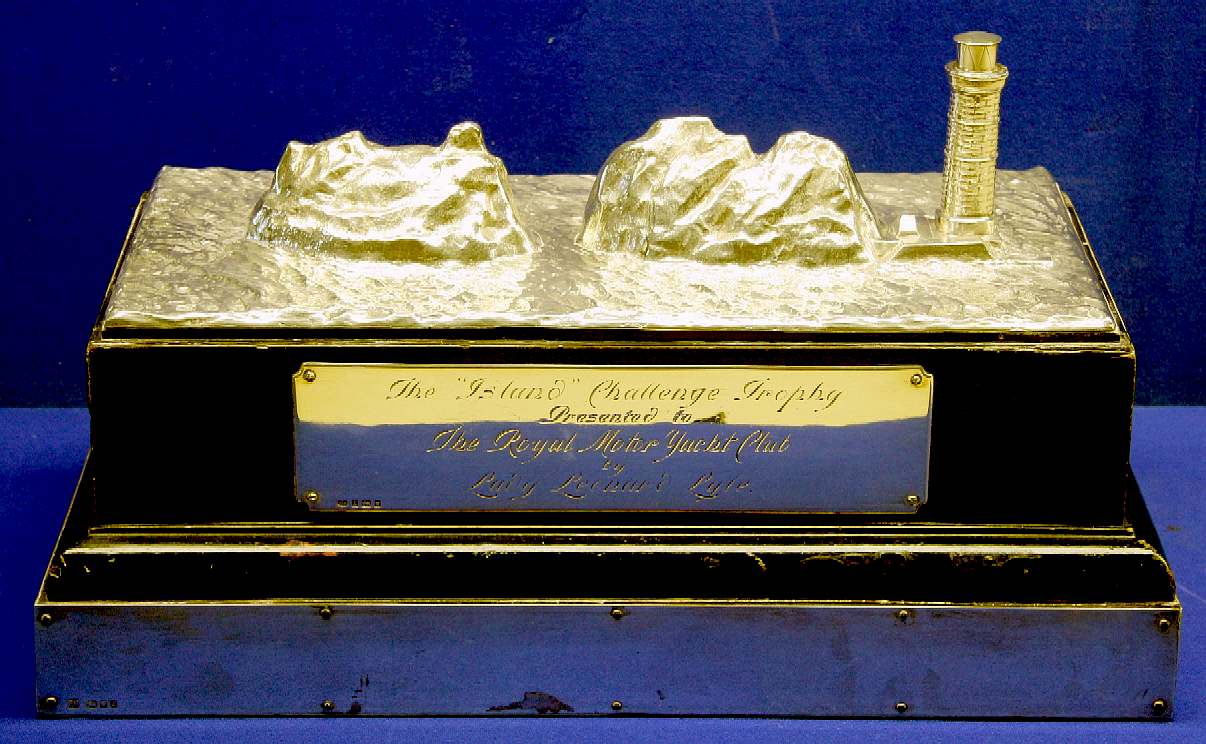
The Needles Trophy is similar in design to the Harmsworth
HISTORY
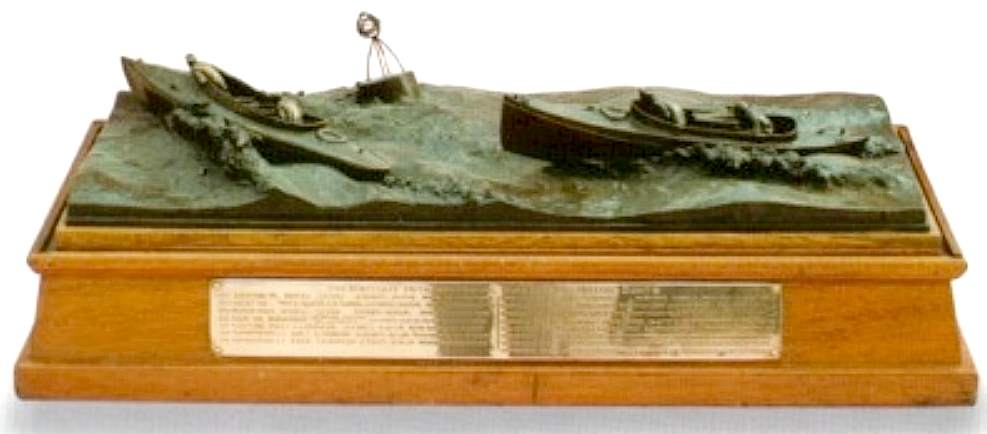
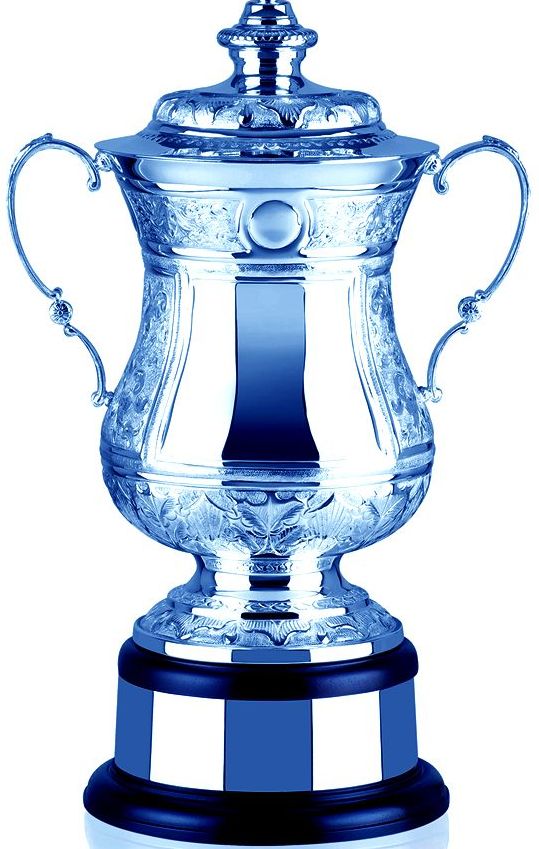
In 1903 - the year that the world's first aeroplane flew, the British International Harmsworth Trophy, now the oldest powerboat racing trophy, was awarded. The Harmsworth Trophy, once the powerboat equivalent of the America's Cup, has lain dormant since 1995 but its reinstatement heralds the preparation for the centennial of the trophy in 2003. A solid bronze trophy was commissioned by Sir Alfred Harmsworth, proprietor of the Daily Mail and a member of the Automobile Club of United Kingdom, as "an effective means of bringing marine motors and the design of launch hulls to a state of perfection'. In this, the trophy has been truly successful through the decades.
But this is not the history of a great trophy, it charters an era of extraordinary pioneers of design both on water, land and in the air - firms such as Thornycroft and Saunders who applied the knowledge from powerboat racing to produce torpedo boats for World Wars One and Two. It is also a rare insight into the characters that invested personal fortunes and risked all to claim this blue riband event. Names such as Tommy Sopwith, Garfield Wood, Betty Carstairs and Dorothy Levitt, each with a remarkable story to tell.
The initial rules for this perpetual trophy were relatively simple: "allowing boats up to 40' in length, with no limitation on engine size, to compete. All boats will carry two hands, of which the helmsman must be an amateur'. It was declared that the hull, engine and crew were to come from the country represented.
Even in the inaugural year when only British competitors gathered at the Royal Cork Yacht Club to race up the River Lee to Cork, a distance of some 8.5 miles, the actual "victor' remains an unanswered question. The name of Selwyn Francis Edge, as owner of the steel-hulled 75 bhp "Napier' which took the winner's flag is etched on the Harmsworth Trophy. However, some reports reveal that Campbell Muir, a friend of Harmsworth, was the nominated driver and probably at the wheel.
There are also references to the legendary woman racing driver, Dorothy Levitt who was also on board, but reports fail to clarify who drove this forty footer to victory. She certainly drove "Napier' to victory in later races and in 1906 she set the women's world land speed record at an astonishing 96mph. Velocity was obviously her forte. But it was not Britain's "custom of the day' to encourage women drivers, in fact, despite racing throughout Europe, she was not allowed to compete at Brooklands. Who knows whether the journalists of the day managed to report this event avoiding the social enigma of accrediting the victory to a woman!
In 1904 the event attracted a field of International competitors with France and America joining the United Kingdom. The final of the three heats in the Solent was delayed at the behest of the King and Queen who wished to watch the racing.
The Royal Yacht, "Victoria and Albert' provided a unique finish line off Ryde Pier where a delighted Selwyn Francis Edge in Napier Minor took the winner's honours. But glory was short-lived as Napier II, Edge's second entry had officially qualified to represent United Kingdom, but was damaged beyond repair after the trials.
The trophy was awarded to Frenchman, Henri Brasier in the 30 ft, 82 horsepowered, Trefle-A-Quatre. As reported in The Motor Boat: "In the actual contest Trefle-a-Quatre was badly beaten, so that she wins, and properly so, by a sheer technicality. The decision caused an eruption, but was not disputed.'
The Automobile Club of France chose the Bay of Arachone to host the 1905 competition for the Harmsworth Trophy where it was a "walk over' for United Kingdom. The French withdrew their entries as a protest against the Automobile Club of France and the Americans withdrew leaving the three British entries to battle for victory. The steel-hulled, Napier II powered by two 4-cylinder 80 horsepower Napier engines, entered now by Lionel Rothschild and the Hon John Scott Montague took the honours with MP Lord Howard de Walden finishing second.
The Motor Boat reported that " the future of the Harmsworth as an International affair is decidedly gloomy' - however, nothing could have been further from the truth.
Lord Montagu went on successfully to defend the Harmsworth crown in 1906 but the following year, America sent the record breaking "Dixie', owned by Edward J Schroeder and driven by Captain Barclay Pearce to win at an average speed of 31.78mph. Tommy Sopwith, designer of the Sopwith Camel won glory back for Britain at the wheel of Sir Mackey Edgar's Maple Leaf IV for two consecutive years, in 1912/3, pushing the average race speed to 56.4 knots, before the first World War stopped further competition.
The trophy continued its unusual career when in 1915, when during a zeppelin raid which set fire to the "Enchantress', home to the Royal Motor Yacht Club and housing the Harmsworth Trophy, all records relating to the trophy were destroyed. The trophy was rescued but the plinth was burnt and was subsequently restored in 1920 by American Gar Wood using mahogany from Miss America 1.
During the 1920s, Garfield Arthur Wood made the Harmsworth Trophy his own, winning an unprecedented nine times. Inventor, engineer, airplane pilot and legendary powerboat racer, Wood made his first million by inventing the hydraulic hoist for dump trucks and at his death he held the greatest number of patents accredited to one person.
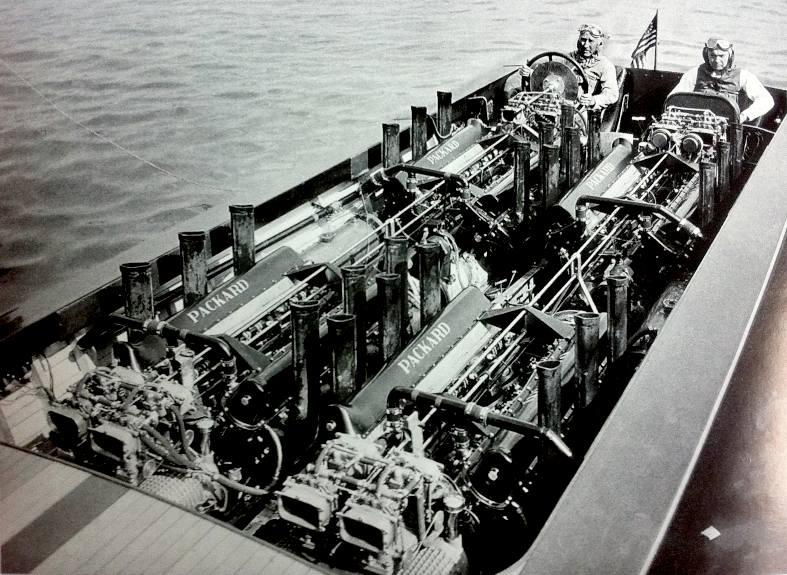
Gar Wood in his Harmsworth Trophy record boat with four V12 Packard engines
The most serious challenge to Gar Wood and his stream of "Miss Americas" came from Marion Barbara Carstairs, known as "Joe", a British oil millionairess. Despite spending considerable sums of money and building four multi-aero-engined 30ft hydroplanes, each costing £30,000 she failed to lift the trophy from the American grasp.
The most sophisticated British challenger appeared in 1931 when Lord Wakefield brought the twin Rolls Royce engined (2000hp each) Miss England II to Detroit. At the wheel was World War 1 flying ace, Kay Don who successfully beat Wood in the first heat - the one and only time Wood was beaten in the Harmsworth competition. Sadly, a false start put paid his any hopes of wrestling the trophy from the USA.
1933 was the British pre-War swan song with Hubert Scott-Paine's Miss Britain II powered by a single 1470hp ex aero engine, which against Wood's 6400hp Miss America X, simply did not stand a chance.
Thus ended an era of competition by giants in innovation, power, speed and cost. For the past 70 years the trophy has followed a chequered career from its home at the Royal Motor Yacht Club to being competed for in Anglo-American challenges in both offshore powerboat racing and circuit racing. Names such as Michael Doxford, the late Stefano Casiraghi, Jonathon Jones and Billy Seebold and more recently Andreas Ugland and Hannes Bohinc join the illustrious line-up of Harmsworth Trophy winners. But, in truth, a real home for the Harmsworth has never been found. Until today.
From 2002 the Harmsworth will be presented to the fastest Endurance monohull - a class which will attract a true field of International competitors - pitting man and machine against the sea and still a class where innovation is reflected in the production cruisers of today. Commenting on the reinstatement of this famous trophy, The Earl of Normanton as Chairman of the Trustees said: "If one looks at the original deed of gift for the Harmsworth, it was a test bed ultimately to improve and develop marine products and production hulls. The trustees feel that we have now found a suitable "home" for this prestigious trophy and we are confident that it will resume its rightful place as the blue riband event of the sport."
The Segrave Trophy was established in 1930 to commemorate the life of Sir Henry Segrave. A former fighter pilot in World War I, Segrave went on to become Britain's top motor racing driver of his era. He was the first Briton to win a Grand Prix in a British car, winning the French and Spanish Grand's Prix in a Sunbeam. He later went on to set the world land speed record, but was later killed setting the world water speed record. The Seagrave Trophy is awarded annually to a British subject who accomplishes the most outstanding demonstration of transportation by land, air or water.
LINKS
Harmsworth-trophy-comes-out-of-retirement http://www.mby.com/news/436415/harmsworth-trophy-comes-out-of-retirement Cowes online Harmsworth Trophy http://cowesonline.com/story?story_id=8031;cp=0
|
|
|
This
website is Copyright © 2014 Bluebird Marine Systems Limited.
The names Bluebird™, Solar Navigator™,Blueplanet Ecostar
BE3™, Utopia
Tristar™ and the blue bird in flight
|